Key takeaways
- NAD+ is a dinucleotide coenzyme; a catalog category does not change its chemical identity.
- NAD+ and NADH are different redox forms and should not be treated as interchangeable assay inputs.
- A measurement of NAD-related metabolites is not, by itself, evidence for a health or longevity claim.
For laboratory research education only. Not medical advice or instructions for human or animal use. RetaSet supplies research materials and publishes this guide; catalog links lead to our own products.
Why NAD+ is not a peptide
A peptide is built from amino-acid residues joined by peptide bonds. NAD stands for nicotinamide adenine dinucleotide: its name points to a different chemical architecture. The NIH’s molecular entry identifies NAD+ as the oxidized form of this coenzyme.
The distinction is useful even if you are simply reading a product list. “Peptide supplier” describes a business category; it does not establish that every listed material is a peptide. Treat searches such as “NAD peptide for sale” as a starting point for checking identity, rather than as a chemically accurate description.
In a laboratory record, use the full compound name and specified form. That avoids an unnecessary ambiguity when the same abbreviated word appears in catalogs, assay manuals and papers.
NAD+ and NADH: the plus sign matters
NAD participates in electron-transfer reactions, cycling between oxidized NAD+ and reduced NADH. Manufacturer assay documentation distinguishes measurements of the total pool from measurements of NADH. The endpoint needs to be stated explicitly.
A report headed “NAD increased” leaves several possibilities open. Did it measure NAD+ alone, NADH, a combined pool, or a ratio calculated from separate measurements? Those answers describe different observations.
The following is a reading aid. It does not replace the definitions and calculation method in the assay protocol.
| Reported endpoint | Question to ask | Why it matters |
|---|---|---|
| NAD+ | Was the oxidized form measured specifically? | A total-pool result is not automatically an NAD+ result |
| NADH | How was the reduced form distinguished? | The redox form is part of the measurement |
| Total NAD | Which forms does this method include? | Definitions must match before comparing reports |
| NAD+/NADH ratio | How were both quantities obtained? | A ratio can change because either quantity changes |
A ratio can change without a larger total pool
Here is a hypothetical arithmetic example, not experimental data. One sample has 8 arbitrary units of NAD+ and 2 of NADH; another has 6 and 4. Both totals are 10, but their NAD+/NADH ratios are 4 and 1.5.
If a summary reports only the total, it misses that difference. If it reports only the ratio, it does not tell you whether the total changed. Keeping the two component measurements visible makes the interpretation easier to audit.
This is also why a claim about “boosting NAD” needs a defined endpoint. Before assessing whether an effect is meaningful, establish exactly what changed, where it was measured and what the comparison was.
What a human metabolite study can—and cannot—answer
A 2019 pilot study investigated plasma and urine NAD-related metabolites during an intravenous NAD+ infusion. Its stated focus was the metabolome: the measured molecules and their changes over time. That is a narrower question than whether a treatment improves health or extends life.
When reading a pilot study, look at its endpoints before borrowing its conclusion for a different purpose. Evidence that a substance or its metabolites can be measured does not establish a clinical benefit. Nor does the route used in a study provide instructions for a supplier’s research product.
For this guide, the study serves as an example of endpoint discipline. We are not recommending an infusion, interpreting an individual’s laboratory result or ranking wellness treatments.
The material specification comes before the assay
If a method requires an oxidized coenzyme, confirm that the supplied material is documented as the required form. Record its identity, lot, stated content, storage information and the analytical evidence relevant to the method. A product name alone is not a complete specification.
Consider a hypothetical procurement note that says only “NAD, high purity.” It leaves the form, method and basis of the purity statement unclear. A useful follow-up request asks for those missing details individually, rather than asking whether the material is simply “good quality.”
Keep product handling instructions attached to the exact material and preparation. Do not borrow a peptide storage rule merely because the products share a catalog page.
Research materials and sterile medicines need different evidence
The FDA has warned compounders about using food-grade NAD+ to prepare intravenous products, citing contamination risks from microbes and endotoxins without appropriate processing. This illustrates why an ingredient’s stated grade and intended use matter.
A chemical identity claim does not establish suitability for administration. Research-use materials in the catalog are presented for laboratory procurement, not as substitutes for prescribed or compounded medicines.
For a research purchase, start with the assay’s specification and resolve missing documentation before use. For a treatment question, the appropriate source is a qualified clinician or pharmacist, not a laboratory product listing.
Common questions
What does NAD plus mean?
NAD+ denotes the oxidized form of nicotinamide adenine dinucleotide. It is a coenzyme rather than an amino-acid peptide.
Is NADH the same as NAD+?
They are related redox forms, but they are not interchangeable labels. Check which form and endpoint a method specifies.
Does a higher total NAD result prove an anti-aging benefit?
No. A biochemical measurement and a clinical outcome are different endpoints. A benefit claim requires evidence designed to test that outcome.
Explore research materials
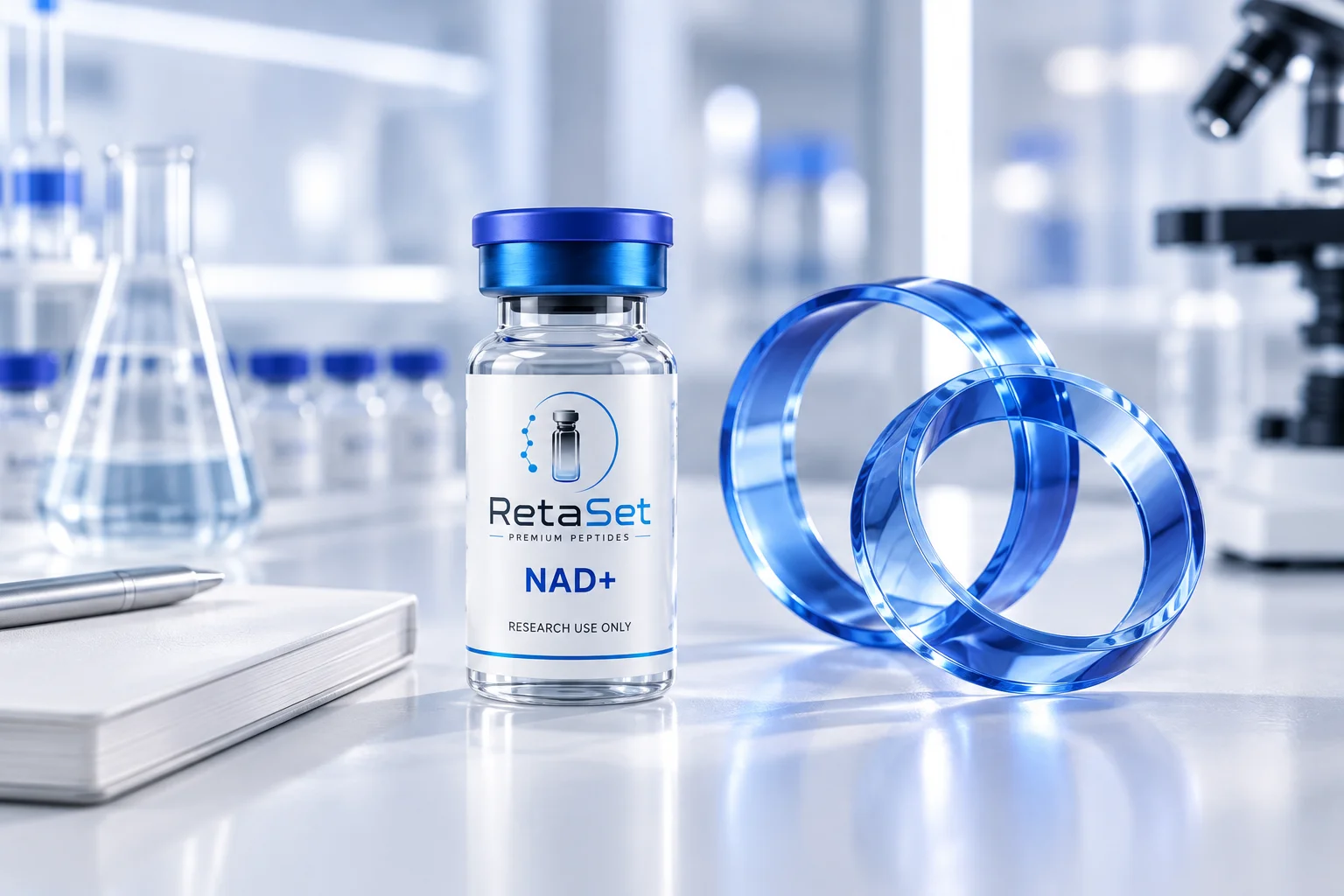
Explore NAD+ laboratory-material specifications in the Research Peptide Catalog. Confirm the documented chemical form and lot information against your method; these links do not recommend personal use.
Product links support research procurement only. Availability and specifications can change. Contact RetaSet for missing product documentation. Read the shipping policy.